Study in Black and White XI
Idea
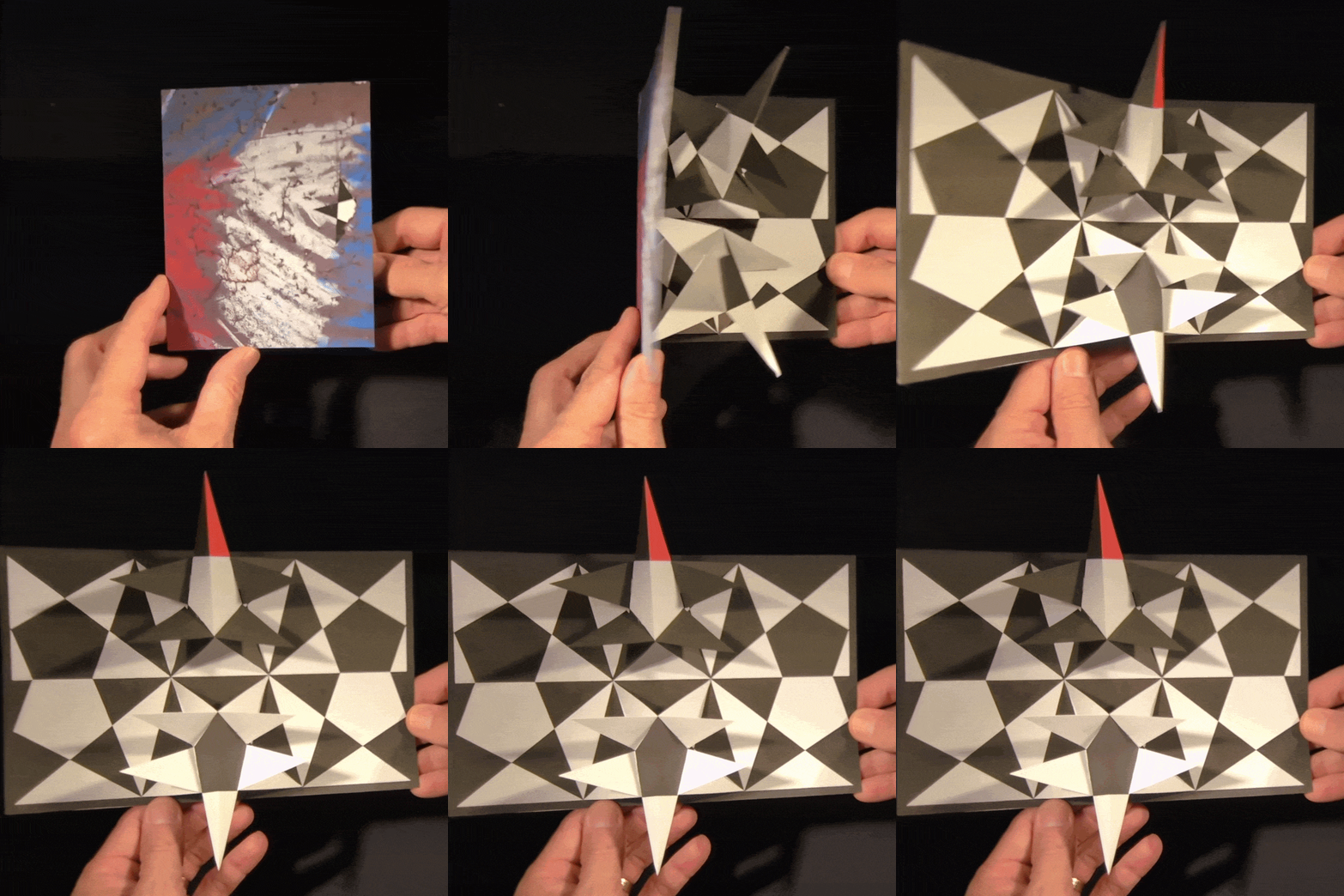
Here’s another study in black and white that breaks a run of three mice cards in a row. I played around with pentagons and pentagrams in the past, but didn’t have any luck with them. I think the main problem is that the odd number of sides makes it more difficult, since pop-ups like things square and symmetrical. This time I found something that turned out pretty well using two pentagrams, mirrored about a horizontal axis.
Design
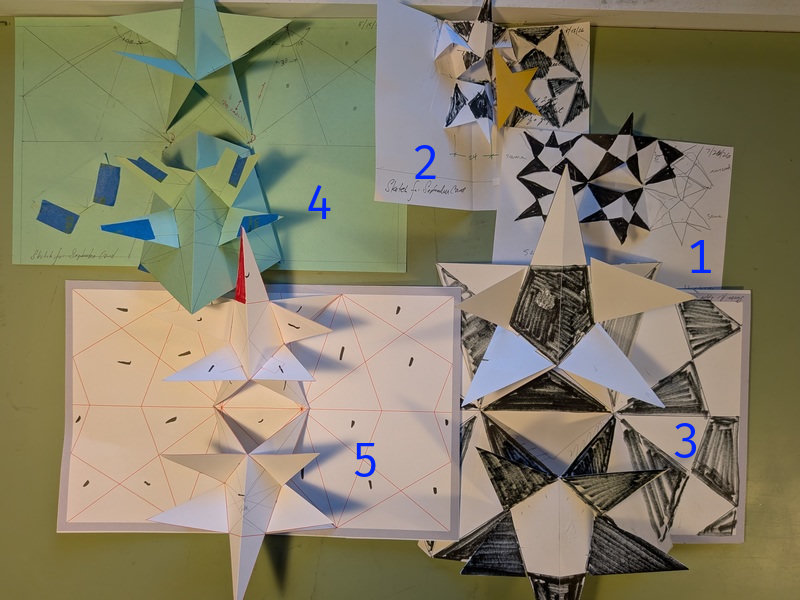
Here are the sketches for this.
 Sketches
Number 1 simply had two pentagrams (stars). With 2, I played around with adding additional Vs on the sides of each star. The gold star was one of the attempts, but all had problems with the pieces colliding when the card was closed. 3 was a full-size one that I added four triangles to each star. I also got very close on what the base would look like. That one used a pentagon with the top point cut out and used the sides of the pentagon to attach it to the base.
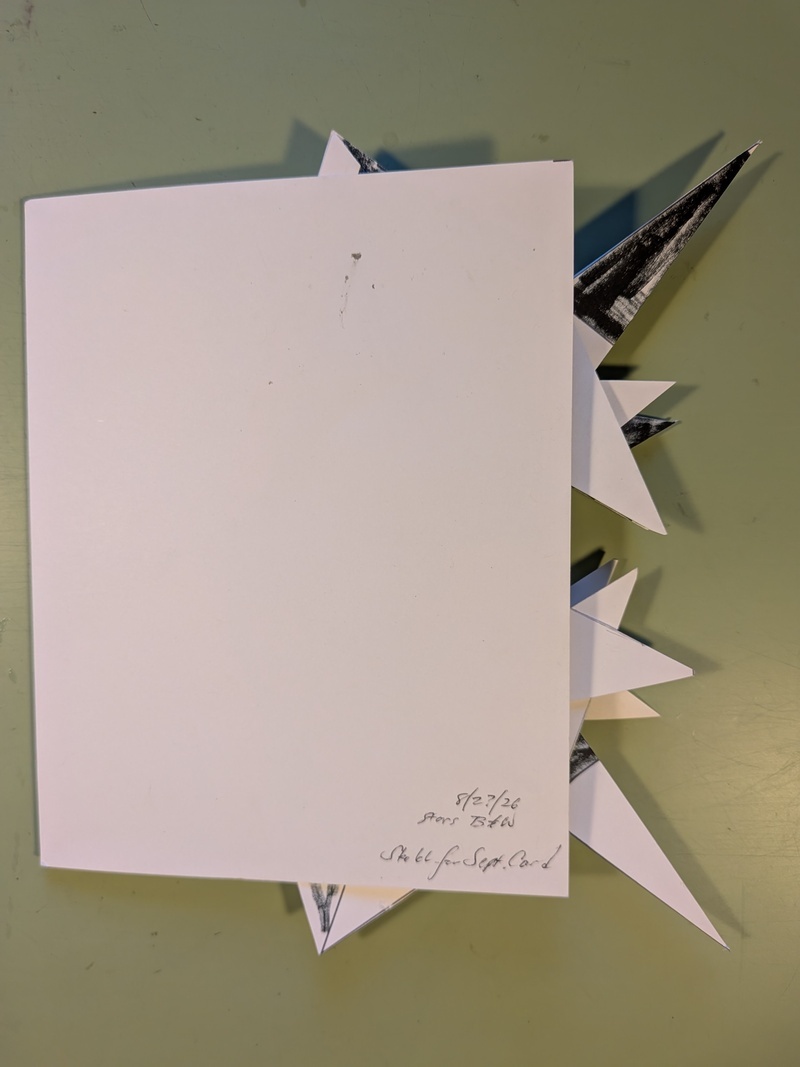
You may notice number 3’s stars are bigger than the other full-size sketches. That was a mistake in my measurements, and when I closed it, they stuck out – just a bit.
 Oops!
Oops!
The fourth one is very close to the final mechanism. The upper star has extra triangles and is now attached only at four points, with pieces of string holding each one down. That is a technique I’ve often seen in Chatani’s books. I used it before, as I mentioned in the October 2024 card. The lower star is a pentagon attached to the sides. I used tape to experiment with the shape of the triangle’s supports.
 Triangle supports
The fifth was a test of printing and cutting of the entire mechanism. I found the points of the stars in the middle were too close and had to be wider. That’s why the stars’ points don’t meet at the intersection of the lines on the base.
My new Silhouette Cameo 5α’s (Thanks, Ma!) print and cut feature is much more accurate. I printed out all of the mechanisms and then had it cut out the stars and triangles. It even cut the slots for the triangle supports just about spot on. (The slots are 9mm x 0.5mm)
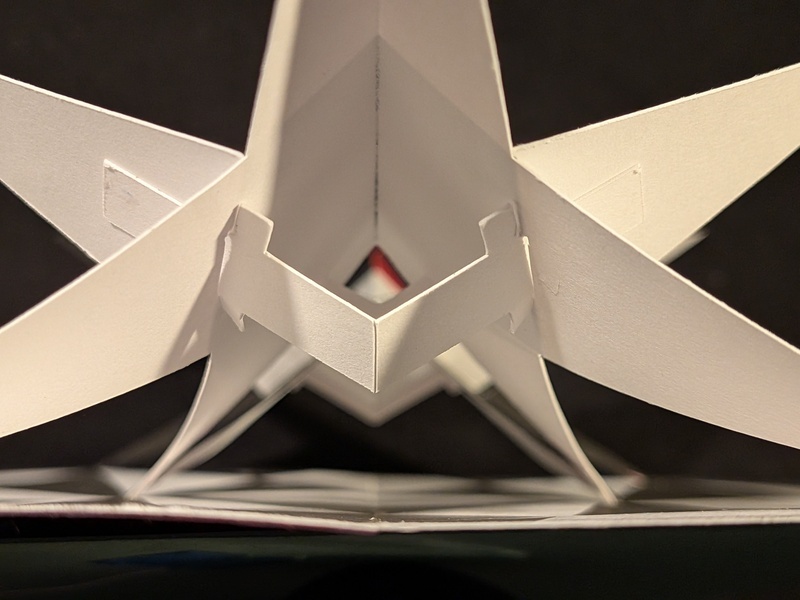
Figuring out the angle and length of the supports was the trickiest part of this card. I went through several iterations before finding ones that worked for both the upper and lower triangles that wouldn’t collide when the card is closed. In the final version, the “lower” triangles’ supports will slide through the star as it closes. If I used a steep angle on the “lower” triangles, they’d close earlier than the “upper” ones and avoid the collision, but they pointed nearly vertically, which I didn’t like.
Here are the backs of the stars ready for assembly. Notice the tabs on all the supports. Even with the test sketches, in the final build I had to remove the “lower” tabs to allow sliding, which avoided collision.
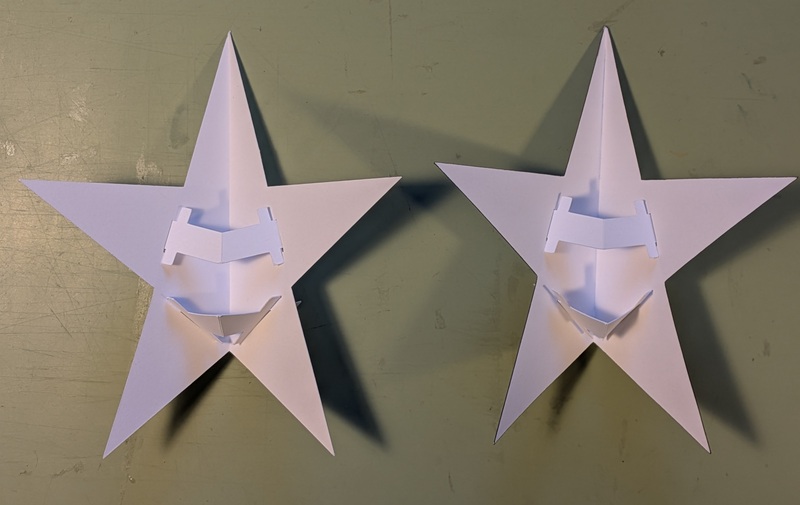 Backs of the stars
To make the black pieces look better, I ran a marker along the edges.
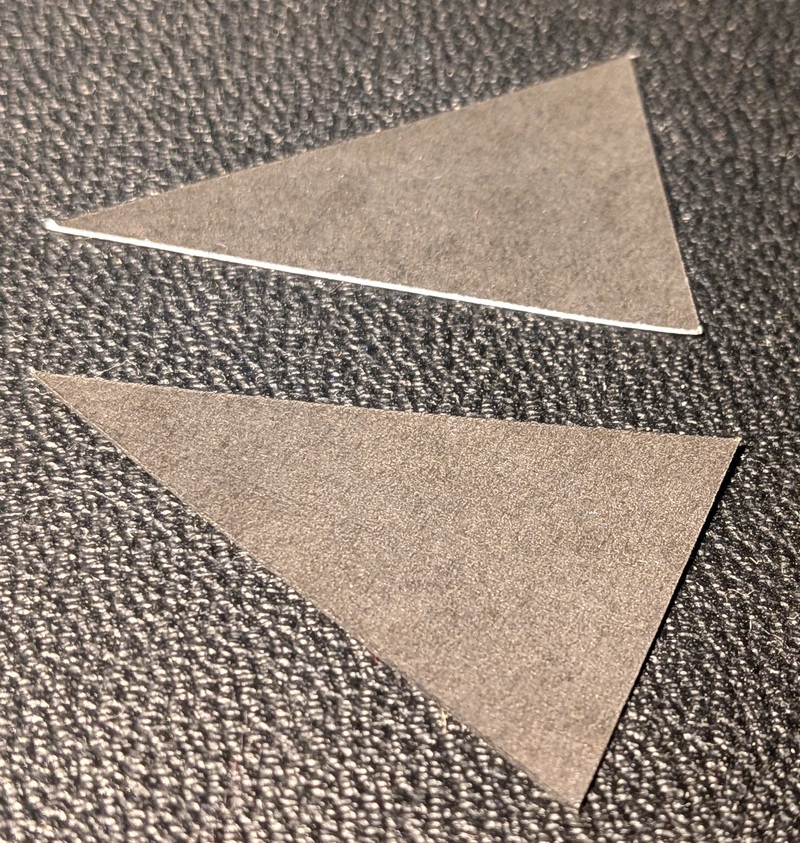 Dark edges
Here are the two stars assembled, with thread glued to four of their points, ready to attach to the base. I poked six holes for the threads and carefully glued them on the back. Wherever I attached a thread, I glued on a piece of paper, just to make sure they don’t come loose.
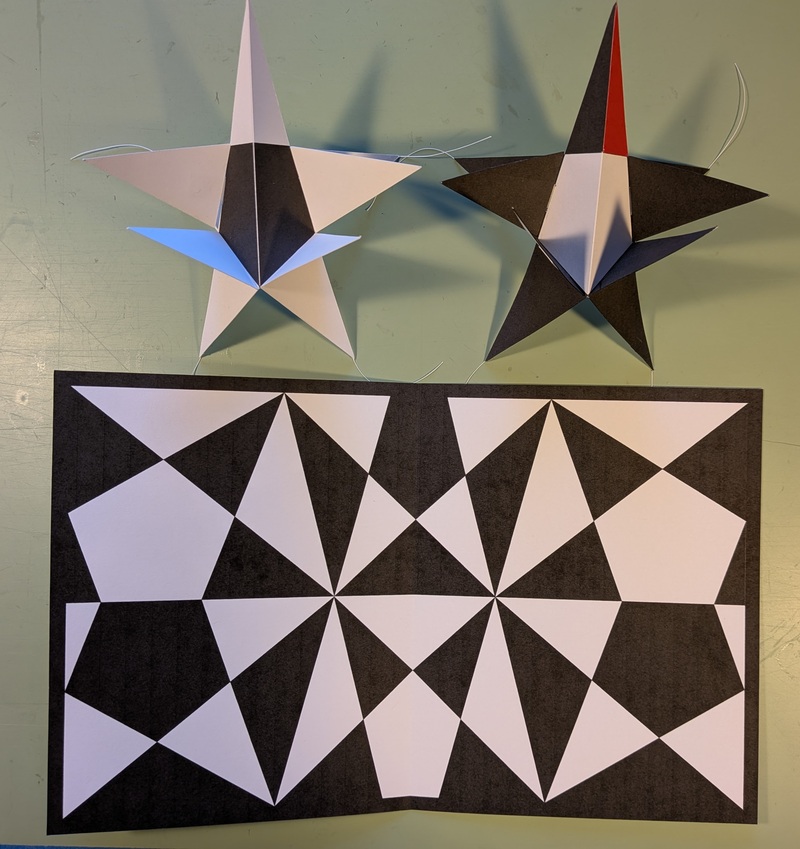 Ready to assemble
Since the thread is glued on the back of the base in six places, the cover will have three threads poking through it. To hide that, I used Howard Jr’s artwork. (They do show on the back of the card.)
The side view shows the stars attached just on the points. This gives it a much more interesting design since you can see under them.
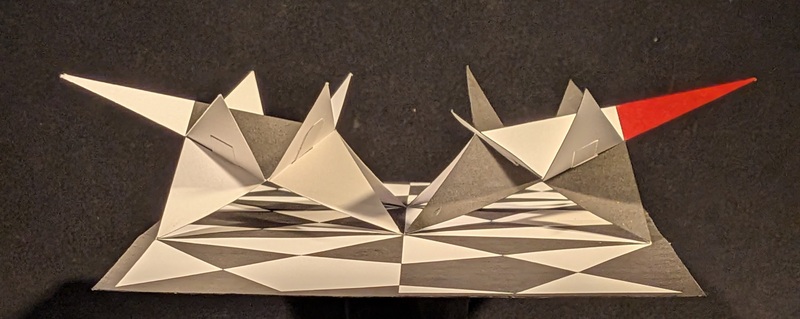 Side view
This Study in Black and White is the first of the second decade of studies. I think it turned out well, although it did remove another regular shape from the list of possibilities.
Cover
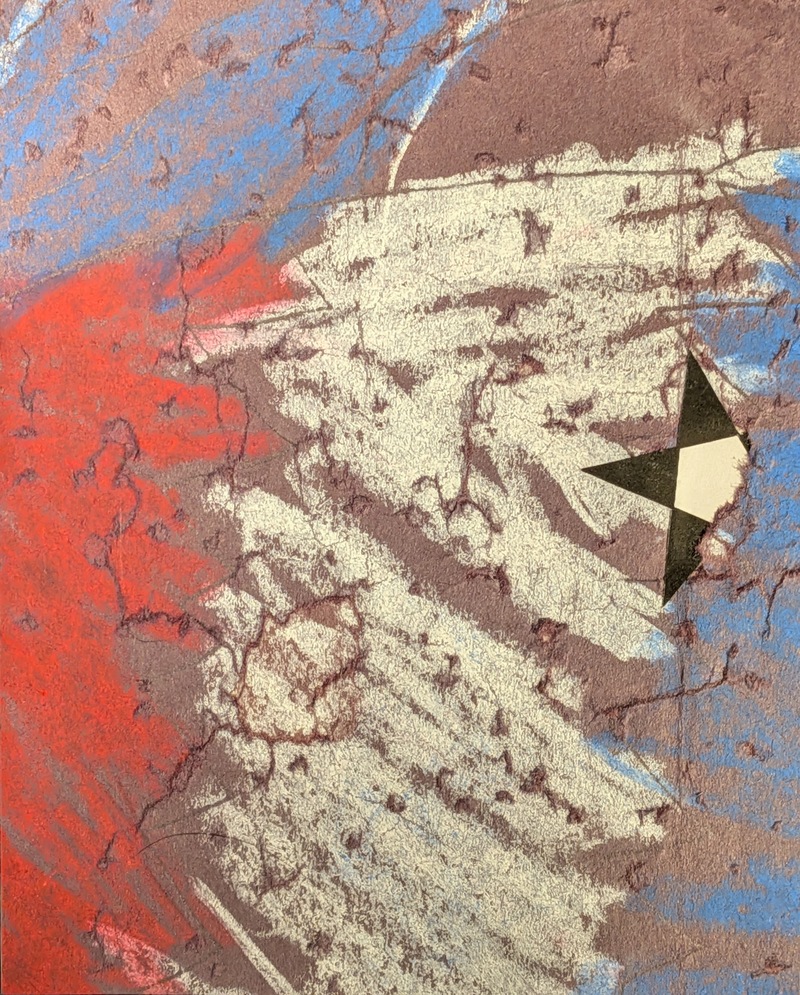
The cover uses a scrounged piece of Howard Jr.’s preschool artwork. I think I may have enough for one more.
Build
- 150mm x 120mm
- The card is index paper with a construction paper layer on the cover.
- Everything was cut by the Silhouette Cameo 5α.